Takachiho Gorge from Fukuoka
Takachiho Gorge sits deep in the mountains of northern Miyazaki Prefecture, and from Fukuoka it is a full-day outing. The guided trips that run there each week spend between nine and eleven hours door to door, and the gorge itself rewards every one of them.
Short answer
Takachiho Gorge is a full-day trip from Fukuoka: the tours that run there take 9 to 11 hours, and there is no direct train from Hakata. Guided trips start from $48 per person, with the best-reviewed option carrying a 4.8 rating across 713 reviews. Closer destinations like Dazaifu or Itoshima suit a half day; Takachiho does not.
Takachiho Gorge is the kind of place that makes the Kyushu day-trip circuit worth planning properly. A basalt canyon cut by the Gokase River, stacked with cliffs, hung with waterfalls, and wrapped in the mythology of the sun goddess Amaterasu, it sits nowhere near a shinkansen line. From Fukuoka it is a commitment: the operators who run there weekly schedule nine to eleven hours for the round trip, and that travel time is the honest answer to the question most visitors ask first.
This page sets out what that commitment involves. It covers how the trip works, what the tours include, how the famous gorge boat ride operates, and how Takachiho stacks up against the other big day trips from Fukuoka. Everything priced here comes from the current tour roster and the city's own published figures.
How Far Is Takachiho Gorge from Fukuoka?
Takachiho is a full-day destination, roughly a third of the way across Kyushu from Fukuoka, and the day-trip products that serve it run 9 to 11 hours end to end. There is no direct train: independent travellers reach the gorge through a chain of rail and bus connections, which is why guided coaches dominate the route. For scale, every operator on the roster brackets Takachiho with Mount Aso, Kumamoto and Beppu, the other full-day reaches of Kyushu, rather than with Dazaifu or Yanagawa.
The distance matters less than the shape of the day. Hakata, the station and ward at the centre of Fukuoka's transport web, links outward in every direction, but the rails thin quickly once you leave the Fukuoka plain. Takachiho town sits in Miyazaki Prefecture, high in the interior mountains, closer as the crow flies to Kumamoto than to the coast. That geography is why the same tours so often pair the gorge with Mount Aso, the vast grassland volcano to its west, or with the shrines of Miyazaki to its east.
Read a competitor article and you will often see a driving time in hours, stated with confidence and sourced to nothing. This page will not do that. What the roster verifies is duration: eleven hours for the Takachiho Gorge and Amaterasu Railway trip with the optional boat, ten hours for the Mount Aso and Takachiho combination, ten hours again for the Miyazaki and Takachiho shrines run. Those are operator-stated figures, and they tell a planner everything a kilometer count would.
The practical consequence is scheduling. A Takachiho day starts early, spends three hours or more each way on the road, and returns to Fukuoka after dark in most seasons. Anyone who has been in Japan for a week will recognise the rhythm: it is the same shape as a Nagasaki or a Kumamoto day, not a Dazaifu afternoon. Our day trips from Fukuoka overview sorts the whole map into what fits a morning and what demands a full day, and Takachiho is firmly in the second group.
Getting There: Trains, Buses and Tour Coaches
Independent travel to Takachiho means a multi-stage journey by train and local bus with no single-ticket through route from Hakata, and most visitors let a coach handle it. The guided tours from Fukuoka run between $48 and $59 per person for the day, which usually undercuts assembling the same trip by public transport once transfers and time are counted. Buy transport in the city itself with an IC card or cash; the Fukuoka Tourist City Pass covers the city and Dazaifu, not Miyazaki.
Start with what does not work, because competitor guides are vague about it. There is no direct JR service from Hakata to Takachiho town, and no high-speed line anywhere near it. The independent route means riding rails part of the way, then transferring to a local bus up the mountain, with connections that are built for residents rather than tourists. It is doable, and determined travellers do it, but it eats the middle of your day and leaves little margin if a connection slips.
The guided alternative is efficient because it collapses all of that into one vehicle. The Takachiho Gorge and Amaterasu Railway tour from Fukuoka, the best-reviewed product on this route at 4.8 across 713 reviews, runs eleven hours and includes the gorge and the scenic railway, with the rowing boat as a paid option. The Mount Aso and Takachiho combination, 4.7 across 674 reviews, does the same gorge in a ten-hour day with a volcano attached. And the Miyazaki, Takachiho Gorge and Shrines tour, 4.6 across 384 reviews, threads shrines and the gorge into ten hours.
Cost behaves the way long-distance days always behave in Japan: the marginal price of the coach seat is low, the price of your time is high. These three trips price from $48 to $59 per person, a band that covers the transport and the guide and leaves the boat as an optional extra. Checking the live listing for each is the only way to see today's exact price and what the current itinerary includes.
One thing worth knowing before you leave the city: the Fukuoka Tourist City Pass, at ¥2,500 for the city version and ¥2,800 with Dazaifu, is checked against your passport at the counter and sold only to overseas visitors on short-stay visas. It covers subway, buses, trams and ferries inside its zone, and Takachiho is far outside that zone, so treat it as a city-and-Dazaifu tool, not a Kyushu rover. The city's own pass page spells out the coverage and the passport rule.
What a Takachiho Day Tour Actually Includes
A standard Takachiho day tour from Fukuoka bundles coach transport, a guide, the gorge walkway, and usually the Amaterasu Railway or a shrine stop, with the rowing boat sold as an optional extra at the gorge. Itineraries run 9 to 11 hours, depart from central Fukuoka in the early morning, and price from $48 to $94 per person depending on the stops. The gorge itself charges no entry fee for the walking path, which is typical for Japanese natural monuments.
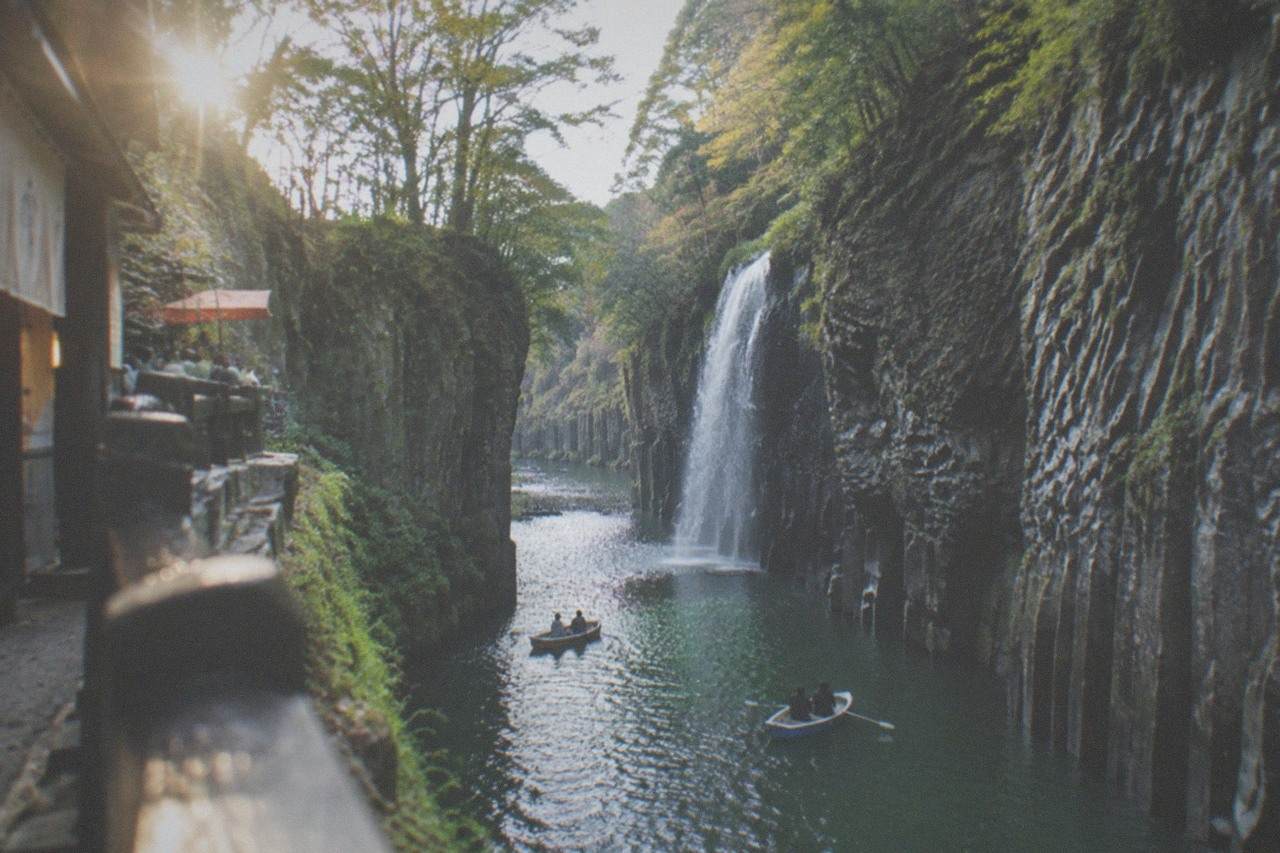
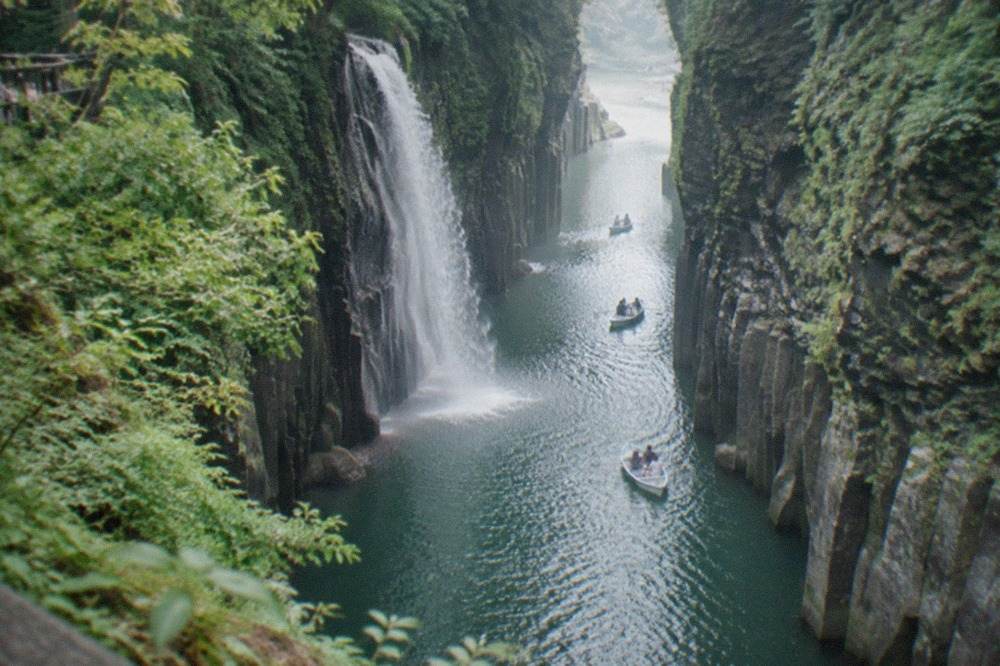
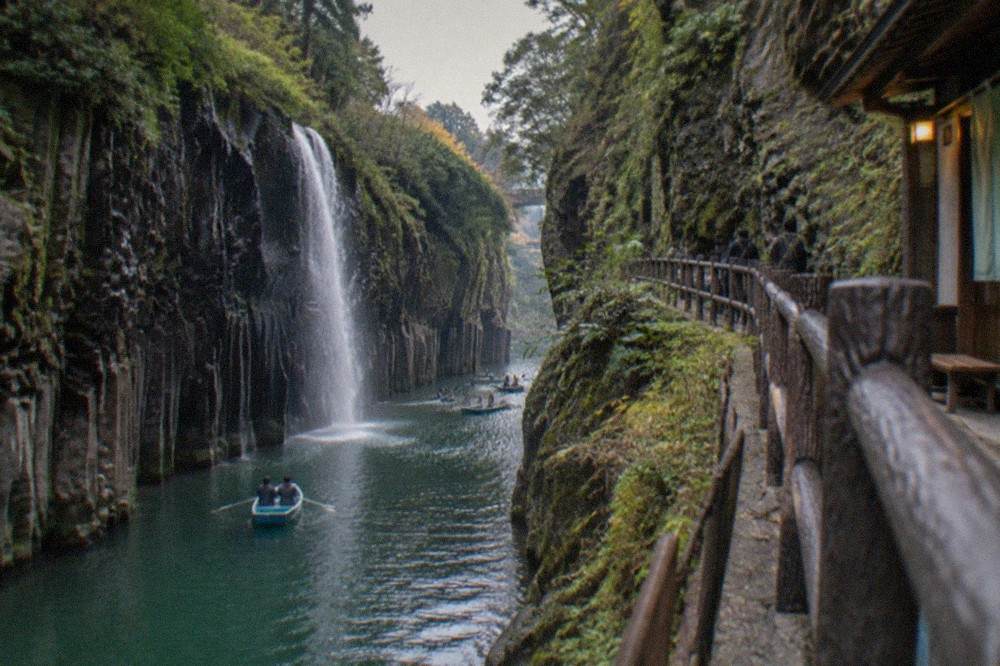
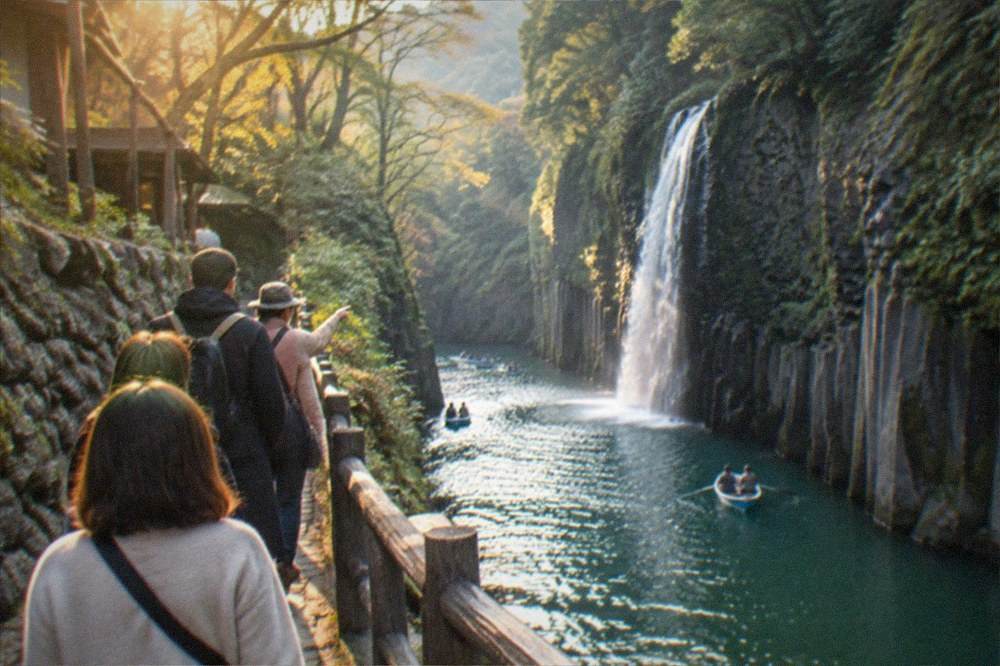
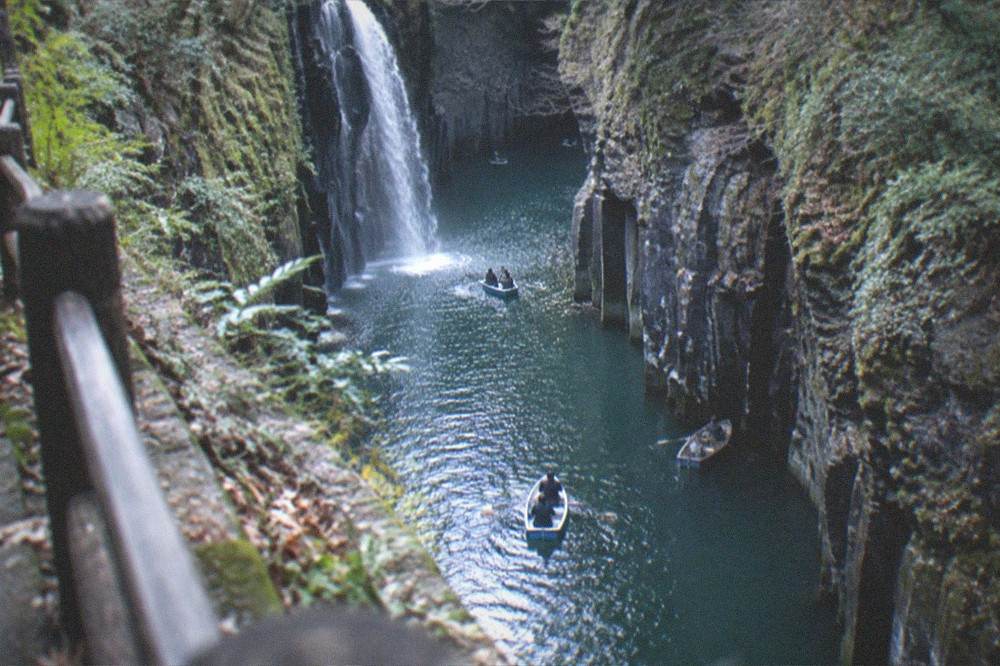
The core of every itinerary is the gorge walk. A paved path runs along the rim, past the Manai Falls, the seventeen-metre curtain of water that anchors almost every photograph of Takachiho, and down to water level where the rowing boats put in. The walk takes an unhurried hour. Tours typically give the gorge the longest single block of the day, then scatter the remaining hours between the railway, a shrine and lunch.
The Amaterasu Railway is the distinctive add-on that separates the top itinerary from its rivals. A former JR line now run as a heritage railway, it hauls open-sided carriages along a hillside route with a long view over the gorge valley, and the tour named for it is the one most travelers pick when the gorge is the priority rather than the volcano. That product, from $48 per person and rated 4.8 across 713 reviews, runs eleven hours and is the roster's most-reviewed Kyushu day trip by a wide margin.
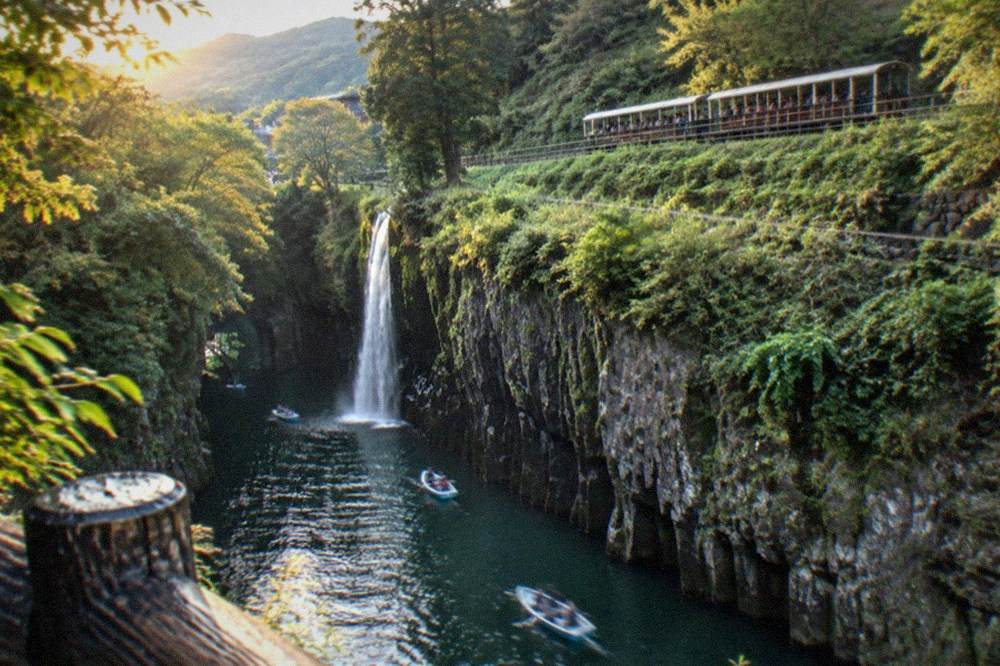
Reviews for the railway tour are unusually specific about what makes it work. Guests consistently mention the guide and the timing rather than the transport, which is the tell of a well-built itinerary: the vehicle disappears into the background and the day stays on schedule. When a trip covers this much ground in eleven hours, punctuality is the product.
If the gorge is the headline but you want something beyond it, the same family of tours fans out quickly. Some visitors prefer the Miyazaki and Takachiho pairing for its shrine stops, others want the Mount Aso combination for the volcano, and a few want Beppu's hells and Yufuin instead, which is a different valley entirely but the same shape of day. The comparison section below lays out the whole field side by side.
The Gorge Boat Ride: Season, Water Levels and Choices
The Takachiho boat ride is a paid optional extra on the tours that offer it, a short rowing-boat circuit on the Gokase River beneath the Manai Falls, and it runs only when the river's water level permits. High water after rain and the depth of winter both suspend it, and no operator guarantees it in advance. Every booking that includes the option states the fee and the refund rule on the live listing, so read that section before you count on it.
Three of the roster's Takachiho products carry the boat as an option. The gorge-and-railway tour is the one that makes it central, and the Mount Aso and Miyazaki combinations each offer it where the day allows. The pattern across all three is the same: the boat is a local payment at the gorge, decided on the day, priced on the operator's listing rather than in the tour's own fee. That structure is honest, and it protects the traveller, because a boat forced through a schedule in high water is a bad product.
Water level is the binding constraint, and it is worth understanding why. The Gokase rises fast in the mountains after heavy rain, and the boats operate only inside a defined band. The Japan Meteorological Agency's own normals for the region show where that risk concentrates: July averages 299.1 mm of rain at the Fukuoka reference station, the wettest month of the year, ahead of June's 249.6 mm despite June carrying the tsuyu rainy-season label. A July trip books the best weather odds in one sense and the highest suspension risk in another.
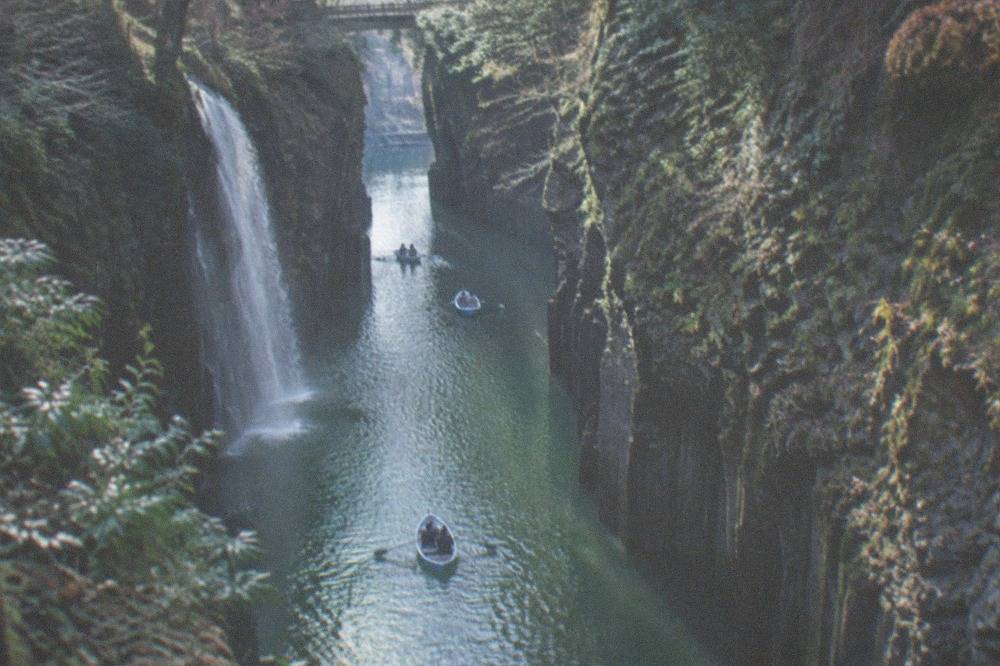
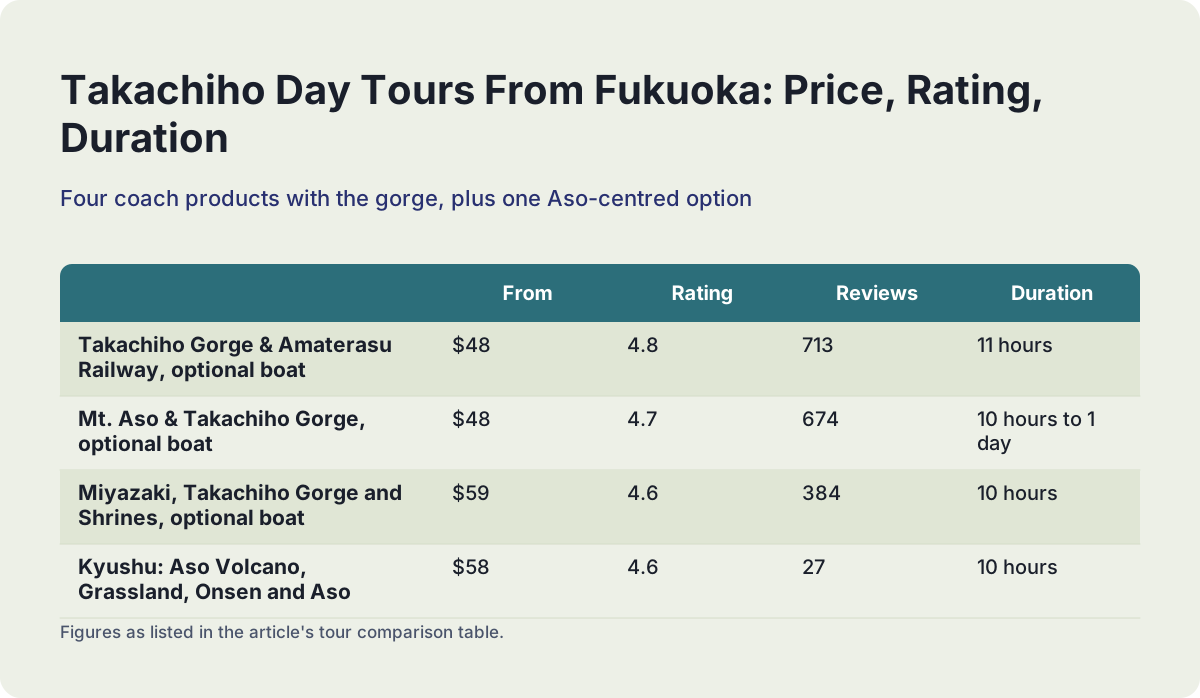
Because the boat is optional and paid locally, the choice between tours should not hinge on it. Compare what each day includes beyond the gorge instead, and treat the boat as a bonus that may or may not be available. The table below puts the three Takachiho-centred tours side by side on the figures that are stable: price, rating, review count and duration.
| Tour from Fukuoka | From (per person) | Rating | Reviews | Duration |
|---|---|---|---|---|
| Takachiho Gorge & Amaterasu Railway, optional boat | $48 | 4.8 | 713 | 11 hours |
| Mt. Aso & Takachiho Gorge, optional boat | $48 | 4.7 | 674 | 10 hours to 1 day |
| Miyazaki, Takachiho Gorge and Shrines, optional boat | $59 | 4.6 | 384 | 10 hours |
| Kyushu: Aso Volcano, Grassland, Onsen and Aso Shrine | $58 | 4.6 | 27 | 10 hours |
The pattern to read in that table is confidence, not just score. Two products carry review pools in the hundreds, one sits near four hundred, and the newest Aso-centred option is building its pool at 27. All four are healthy bookings; they are just at different stages of accumulating public evidence, and printing the count beside the rating, as the table does, keeps the claim honest.
Beyond the Gorge: Shrines, Caves and the Amaterasu Legend
Takachiho town is a mythology destination as much as a scenery one: this is where Amaterasu, the sun goddess, is said to have hidden herself in a cave, plunging the world into darkness until the other gods lured her out. The key sites are Amano Iwato Shrine, the cave itself, and Takachiho Shrine in the town centre, and most tours work in at least one of them around the gorge. The gorge walk and the legend are the same story told in two mediums.
The cave legend is the reason the town exists as a destination at all. Amano Iwato Shrine sits a short local ride from the gorge, guarding the rock where the sun goddess withdrew, and a riverside path leads to the viewing spot. Takachiho Shrine, older and closer to the town's accommodation, hosts the Yokagura, a night-long masked dance sequence that retells the Amaterasu story in thirty-three parts across the winter months. Neither site is ticketable through the day-trip products on this roster, which is worth knowing: the tours handle the transport and the timing, and the shrines are visited as grounds, the standard arrangement for Japanese shrines. More of these guides are collected on Fukuoka Japan Travel Guide.
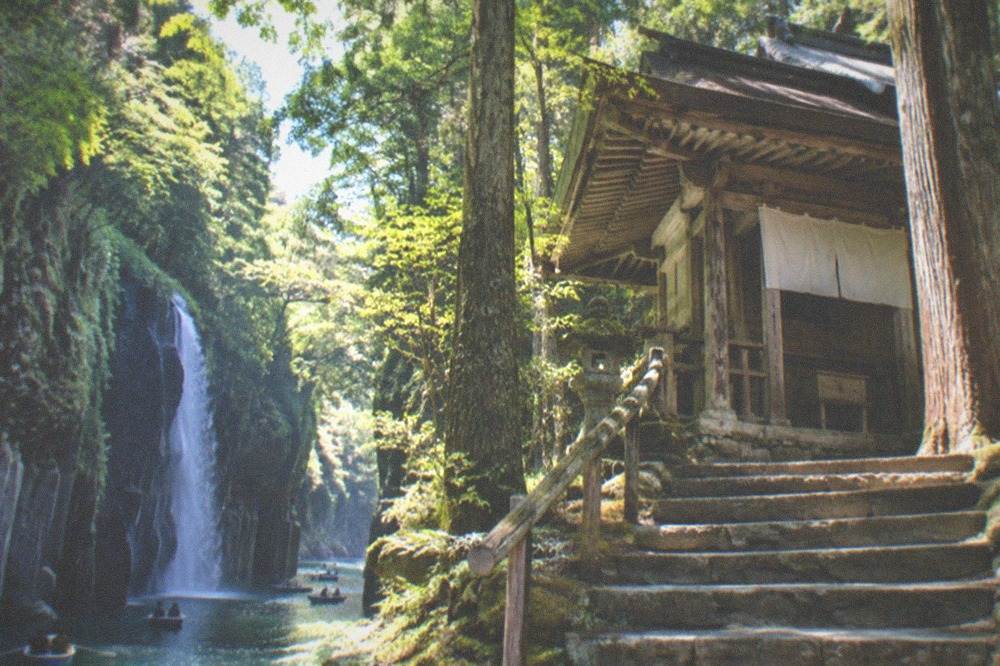
What this means for choosing a tour is that the "beyond the gorge" content is the real differentiator, because the gorge itself is identical on every itinerary. The railway tour trades a shrine for the train ride. The Miyazaki pairing leads with shrine stops. The Aso pairing swaps mythology for a live volcano and a grassland caldera. None of these is a better product in the abstract; they are better or worse for a particular traveler's list, and the honest comparison is stop by stop, not score by score.
One more practical note: everything in Takachiho is close together once the coach arrives, but nothing between Fukuoka and Takachiho is. There is no sensible bail-out point mid-route, no attraction worth breaking the day for, and no faster way back if the mountains disappoint. This is a there-and-back trip, planned as one block.
Takachiho Compared with Other Fukuoka Day Trips
Against the rest of the day-trip field from Fukuoka, Takachiho is the interior-mountain pick: it matches Beppu, Yufuin and Kumamoto on day length, beats the coastal trips on drama, and loses to all of them on transport simplicity because nothing about it is direct. Tour pricing clusters between $46 and $96 per person for the full-day options, with private versions higher. Choose Takachiho for myth and geology, choose the coast for ease, and choose Aso for the volcano if you want both.
The honest way to compare day trips is by what the day costs in hours and what it returns in impressions. The table below puts the major full-day tours from the roster side by side. Prices are per person, ratings carry their review counts, and durations are operator-stated.
| Day trip from Fukuoka | From | Rating (reviews) | Duration | Character |
|---|---|---|---|---|
| Takachiho Gorge & Amaterasu Railway | $48 | 4.8 (713) | 11 hours | Gorge, myth, heritage railway |
| Mt. Aso & Takachiho Gorge | $48 | 4.7 (674) | 10 hours to 1 day | Volcano caldera plus gorge |
| Beppu Hells, Frog Temple & Yufuin | $96 | 4.4 (106) | 10 hours | Hot springs and shopping street |
| Beppu Hells tickets incl. Yufuin & Nyoirinji | $48 | 4.7 (285) | 1 day | Hells with a frog temple detour |
| Yufuin, Beppu, Sapporo Brewery & AoT Museum | $55 | 4.7 (51) | 9 hours 30 minutes | Museums and brewery added |
| Itoshima Hidden Gems | $69 | 4.6 (31) | 8 hours 30 minutes | Coast, beaches, seafood |
| Private Nagasaki full day | $858 | 5 (12) | 12 to 13 hours | Private history deep-dive |
Two patterns stand out. First, the Takachiho products hold the two largest review pools on the board, 713 and 674, which is public evidence that the route works, week after week, for a lot of people. Second, Beppu and Yufuin dominate the alternatives because they are reachable, comfortable and famous, which makes Takachiho the contrarian pick: fewer international visitors proportionally, more road, and a payoff that is harder to find anywhere else in Japan.
The Beppu-and-Yufuin cluster deserves a proper look before you decide. Our Beppu day trip guide and Yufuin day trip guide cover the hot-spring pair in depth, and the Kumamoto day trip guide handles the castle-and-city option that pairs naturally with Aso. If a mountain-interior day appeals but Takachiho feels like too much road, the Kurokawa Onsen trip is the gentler version of the same landscape.
The Beppu Hells tickets product that includes Yufuin and the Nyoirinji frog temple is the quiet value play in that cluster: from $48 per person, 4.7 across 285 reviews, a full day. It sits in the same price band as Takachiho while returning a completely different day, which makes it the single best comparison point for anyone torn between the gorge and the hot springs.
When to Go: Weather, Crowds and the Typhoon Window
The best window is late April through June, when the mountains are green and the heat is still short of the August peak, with May averaging 133.7 mm of rain against July's 299.1 mm. August is the hottest month at a 28.4°C mean, and the typhoon window runs roughly July through October, so summer bookings need a contingency mindset. Autumn colour and the Yokagura season make November a strong runner-up.
The climate figures below come from the Japan Meteorological Agency's 1991 to 2020 normals for the Fukuoka reference station, the coast rather than the mountains, so read them as the regional baseline and expect Takachiho itself to run a few degrees cooler at any time of year.
| Month | Mean temperature | Rainfall | Planning read |
|---|---|---|---|
| April | 15.4°C | 118.2 mm | Green season, mild days |
| May | 19.9°C | 133.7 mm | Best overall window |
| June | 23.3°C | 249.6 mm | Tsuyu rains, greenest mountains |
| July | 27.4°C | 299.1 mm | Wettest month, boat risk |
| August | 28.4°C | 210.0 mm | Hottest, humid, typhoon watch |
| October | 19.6°C | 94.5 mm | Dry, clear, cooling |
| November | 14.2°C | 91.4 mm | Autumn colour, quiet |
The counterintuitive line in that table is July. Every generic Japan guide tells you to avoid July for rain, but the actual normals say June and July are close, and July is when the region stages its biggest events. For Takachiho the trade-off is sharper: the highest suspension risk for the boat, but also the fullest rivers and the loudest waterfalls. If the boat matters to you, May and October are the safer months. If the gorge walk alone is enough, July's drama is a legitimate choice.
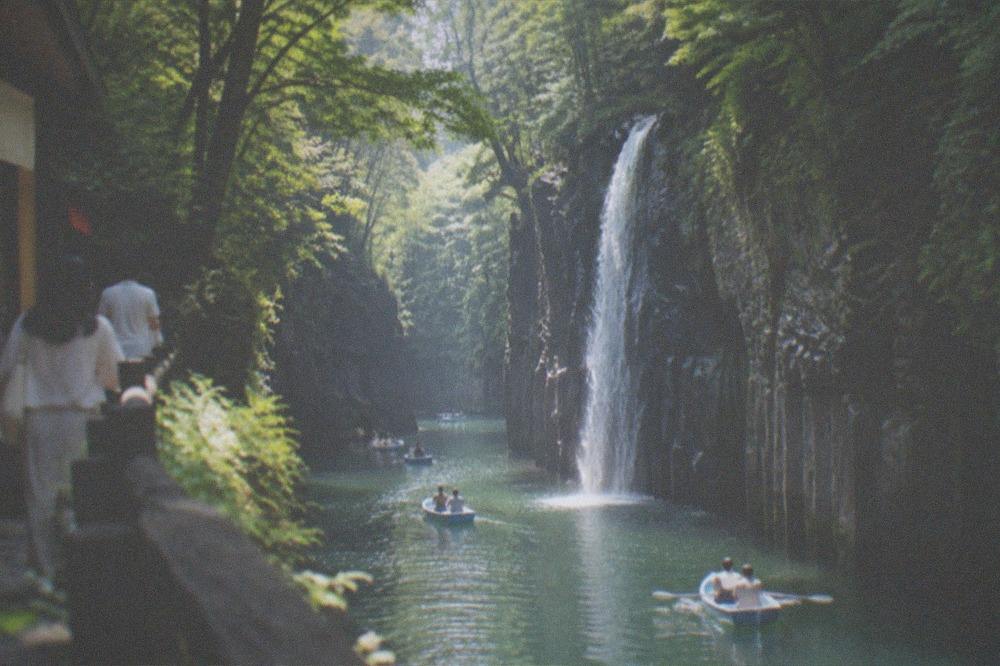
Winter deserves a word, because it is the season the crowd-shy traveler should consider seriously. The mountains are cold and the boat is often suspended, but the Yokagura dance season is running, the gorge is quiet, and the frost on the basalt is its own photograph. The trade is transport risk: mountain roads in ice are a real factor, and tours run less often. Check the live listing's calendar rather than assuming winter frequency.
There is one more way to do this trip, and it suits a particular kind of traveler: skip the fixed itinerary entirely. A customisable private tour with a local guide, from $59 per person and rated 4.9 across 106 reviews, lets you set the pace, the stops and the length, and while it is built as a Fukuoka city product, the private-guide format extends naturally to a slower Kyushu day for travelers who book it that way.
Putting the Day Together
A sensible Takachiho plan from Fukuoka looks like this: book the railway-and-gorge tour for a May or October date, decide on the boat when you arrive at the water, treat the fee as a local payment, and plan nothing else for that day. The trip is 9 to 11 hours, the itinerary is fixed, and the reward is the single most dramatic landscape within day-trip range of Fukuoka.
The one mistake to avoid is the half-day fantasy. Takachiho cannot be combined with a second destination in one day, and it cannot be reached in an afternoon from Fukuoka. The Miyazaki from Fukuoka guide covers the eastern extension if you want to build a two-day loop rather than compress, and the honest advice is to give the gorge its own full day and treat everything else in the region as a separate decision.
The operator's live listing for each product is the final authority on price, inclusions and the current calendar, and every figure on this page traces back to the current roster. Beyond that, the planning is simple: pick your season against the rainfall table, pick your stops against the comparison table, and let the coach do the driving.
Common Questions About Takachiho Gorge from Fukuoka
How Far Is Takachiho Gorge From Fukuoka?
A full day's travel: the tours that serve it run 9 to 11 hours door to door, and there is no direct train from Hakata. Takachiho sits in the interior mountains of Miyazaki Prefecture, closer to Kumamoto than to the coast, and every operator brackets it with the other full-day Kyushu destinations rather than the half-day ones.
Can you get to Takachiho Gorge by public transport from Fukuoka?
Yes, but it is a chain: rail part of the way, then a local bus up the mountain, with no single through ticket from Hakata. It works, and residents use it, but it consumes the middle of the day and leaves no margin for missed connections. That is why guided coaches hold the two largest review pools on this route.
How much does a Takachiho day tour from Fukuoka cost?
From $48 per person for the gorge-and-railway tour, and the two other Takachiho-centred options price from $48 and $59. The rowing boat at the gorge is a separate optional payment on the day, decided against the water level. Exact prices and inclusions for today's departures are on each operator's live listing.
Is the Takachiho boat ride worth it?
As an optional extra, yes, when it runs. The ride is a short rowing circuit beneath the Manai Falls on the Gokase River, and high water after rain or the depth of winter suspends it. May and October carry the lowest suspension risk on the rainfall normals; July carries the highest. No operator guarantees it in advance, so treat it as a bonus rather than the reason to book.
What else is there to do in Takachiho besides the gorge?
Amano Iwato Shrine, the cave where Amaterasu is said to have hidden, and Takachiho Shrine in the town centre, which hosts the winter Yokagura masked dances. Most tours work in at least one shrine around the gorge walk, and the Amaterasu Railway heritage train is the other signature stop on the top itinerary.
Which is better, Takachiho or Beppu and Yufuin as a day trip from Fukuoka?
Different days entirely. Takachiho is the interior-mountain pick: myth, basalt cliffs and a waterfall, with the most-reviewed tour on the route at 4.8 across 713 reviews. Beppu and Yufuin are hot springs and shopping streets, reachable and famous, from $48 to $96. Choose Takachiho for drama and legend; choose the Beppu cluster for comfort and ease of access.